CSCI 370: Sample Final
This is a sample final provided by Professor Greenberg for CSCI 370 Software Engineering
CS 370 Software Engineering Sample Final (Summer 2022)
There may be more than one answer to a question. Choose the best answer to each question. To get any credit for matching questions, all matches must be correct.
Note, if you wish, you can write an explanation next to your answer.
Q1. CD/CI (pipeline):
(1) CD stands for Configuration Development
(2) Makes frequent deliveries of software
(3) CI stands for Configuration Integration
(4) Is used together with the Waterfall process
(5) Should occur once every month
Solution
(2) Makes frequent deliveries of software
Q2. A Non-Functional Requirement
(1) Is usually implied from a Functional one.
(2) Is an unnecessary requirement.
(3) Is a requirement that cannot be made to work.
(4) Usually has a smaller scope than a functional one
(5) Is not related to customer satisfaction.
Solution
(1) Is usually implied from a Functional one.
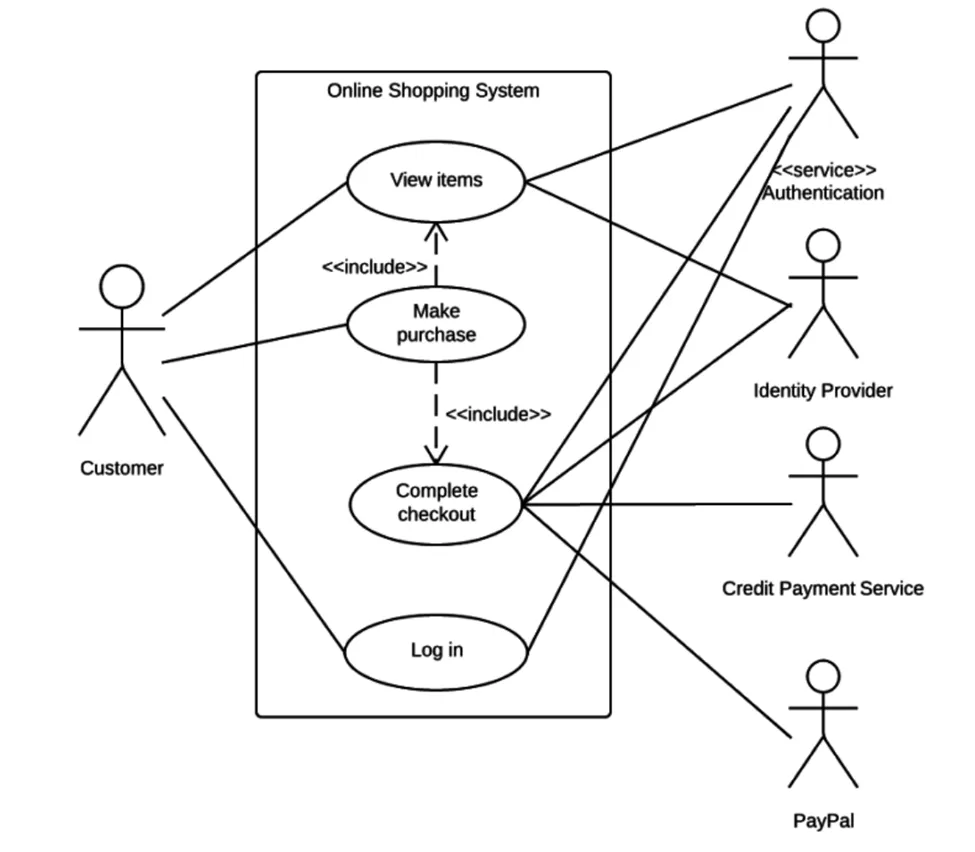
Q3. RE: the diagram below:
(1) “Credit Payment Service” must log in.
(2) Customer can only perform two activities.
(3) Paypal is a service not an Actor.
(4) Complete Checkout interacts with the most Actors.
(5) Is a Context diagram (it’s a Use Case diagram)
Solution
(4) Complete Checkout interacts with the most Actors.
Q4.
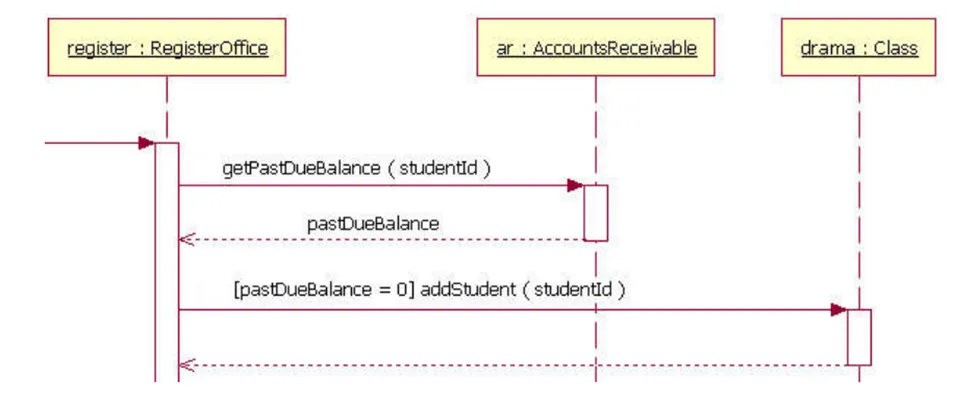
Q4. In the above diagram, which Object is activated the most?
Solution
Register: RegisterOffice
Q5. How many lifelines are there?
Solution
3
Q8. The following pattern is typically used for undoing user actions.
(1) Observer Pattern - adding observers w/out modifying existing code
(2) Strategy Pattern - Separate the code that changes into a separate object which is then passed to code that does not change. Placing algorithms in a separate object that is passed into another class. encapsulating behavior into separate classes.
(3) Factory Pattern - Controls which class gets created. Does not allow programmers to create a specific class.
(4) Command Pattern - placed commands into objects and has two commands execute and unexecute. These commands can be saved for reuse.
(5) Iterator Pattern - e.g. List of Students in a school. The School hides the internal storage of the student list from other objects. Therefore other objects traversal through the Students without knowing how the Student list is being stored.
(6) State Pattern - Have separate pre-defined states for different conditions
(7) Decorator - chain together multiple objects and treat them as one object. i.e. getPrice can get the price of many types of condiments.
(8) Memento - placing a snapshot of an object in another object
(9) Builder:
- (i) Protects an object from bad values
- (ii) Breaks parameters into smaller understandable parts
(10) Singleton - protects a global variable (i.e static) from bad values
Solution
(4) Command Pattern
Q8. The following is NOT part of a Software development life cycle:
(1) Daily Meeting
(2) Targeting Rule
(3) Analyze Current System
(4) Feasibility Study
(5) Scrum
Solution
(2) Targeting Rule
Q9. The following is not good software practice:
(1) De-Coupled Code
(2) Using inheritance to handle different behaviors
(3) Strategy Pattern
(4) Using composition to handle different behaviors
(5) Using interface types for method parameters
Solution
(2) Using inheritance to handle different behaviors
Q10. A state diagram:
(1) Focuses on changes to a system/object during program execution
(2) Sequence of messages between objects in an interaction (sequence diagram)
(3) Represents the goals of systems and users (requirements/checklist/use case table)
(4) The interactions between a system and other actors with which the system is designed to interface (context diagram)
(5) An informal, general explanation of a software feature written from the perspective of the end user or customer (user story)
Solution
(1) Focuses on changes to a system/object during program execution
Q11. The following is a non-functional requirement:
(1) Scalability - ability of software to grow (or shrink)
(2) Page Color
(3) Business Rule
(4) Report
(5) Search Feature
Solution
(1) Scalability - ability of software to grow (or shrink)
Q12. Non-functional vs functional requirement:
(1) A missing functional requirement usually causes the software to be unusable by the user
(2) A missing non-functional requirement usually causes the software unusable by the user
(3) Software performance is a functional requirement
(4) Web page background color is a non-functional requirement
(5) Non-Functional requirements are easy to test
Solution
(2) A missing non-functional requirement usually causes the software unusable by the user
Q13. A lifeline is found in the following diagram:
(1) Sequence Diagram
(2) Interactive Diagram
(3) Class Diagram
(4) Object Oriented Diagram
(5) Context Diagram
Solution
(1) Sequence Diagram
DP3)
public class Session {

    private static Session _session = null;

    public Session getSession() {

        if (_session == null)
            _session = new Session();

        return (_session);
    }
}
DP3) Which Design Pattern is shown in the code above?
Solution
Singleton
DP3. Explain
Solution
[Insert Explanation Here]
public interface MathFunctions {

    double multiply(double a, double b);

    double divide(double a, double b);
}

public class Calculator implements MathFunctions {

    @Override
    public double multiply(double a, double b) {
        return (a * b);
    }
}
OOP15. Anything wrong with the code above?
Solution
Calculator is not implementing the divide method
Q15. The diagram below is a:
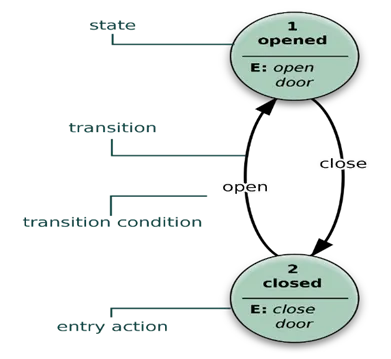
(1) Activity Diagram
(2) Use Case Diagram
(3) Door Diagram
(4) Timing Diagram
(5) State Diagram
Solution
(5) State Diagram
Q16 and Q17.
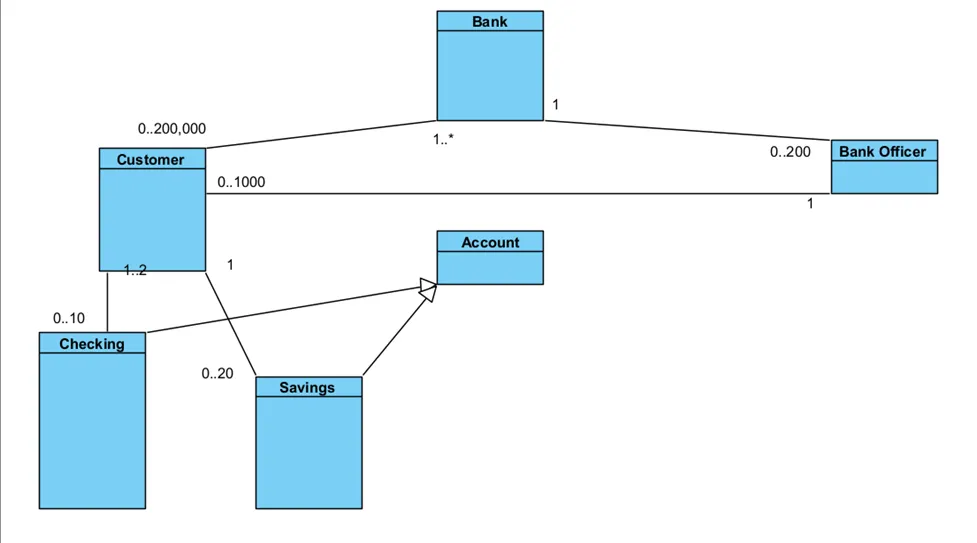
Based on the diagram above:
Q16. Customer can have, at most, this many accounts.
Solution
30
Q17. Bank Officers can have, at most, this many Customers.
Solution
1000
Q18. Match the terms on the left with terms on the right. (All choices must be correct to get credit for this)
Waterfall Process ___
Incremental Process ___
Software Re-Use ___
Client Server ___
1) Email Program
2) Using Open-Source Software
3) Allows many changes
4) Airplane Flying Software
Solution
Waterfall Process - 4) Airplane Flying Software
Incremental Process - 3) Allows many changes
Software Re-Use - 2) Using Open-Source Software
Client Server - 1) Email Program
Q19. Which of the following are attributes of Good Software?
(A) Acceptability and Usability (easy to use)
(B) Dependability and security (won’t crash and will protect data)
(C) Efficiency (won’t waste resources)
(D) Maintainability (easy to fix)
(1) C
(2) A, B
(3) A, C, D
(4) A, B, C, D
(5) None of the above
Solution
(4) A, B, C, D
Q20.
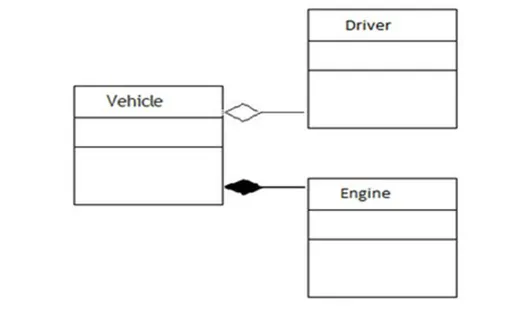
Q20. The diagram above shows:
(1) Inheritance vs Aggregation
(2) Aggregation vs Abstraction
(3) Composition vs Aggregation
(4) Engine does not require a vehicle
(5) Vehicle requires an Engine.
Solution
(3) Composition vs Aggregation
Q21. Dependency Inversion Principle
(1) Encourages using interfaces as opposed to concrete classes
(2) Encourages code decoupling
(3) Specifies that high level modules should not depend on low level modules.
(4) 1, 3 above
(5) 1, 2, 3
Solution
(5) 1, 2, 3
// Account depends on SqlServer therefore Sqlserver is lower than Account therefore
// SqlServer is considered to be lower than Account because is depending on it
// dependency inversion replaces the concrete dependency with abstraction i.e. the interface. Replace SqlServer with IDatabase

class Account {
    SqlServer database;
}

class SqlServer {

}
Q23. The code above:
(1) Violates the Open Closed Principle
(2) Violates the Abstraction Principle.
(3) Violates the Encapsulation Principle.
(4) Uses the Singleton pattern
(5) Uses the Factory Pattern
Solution
(1) Violates the Open Closed Principle
Q24. Which of the following tests are valid Unit Tests:
public class MathTest {

    @org.junit.jupiter.api.Test
    void test1() {
        Math math = new Math();
        System.out.println(math.Execute("add", 1, 2));
    }

    @org.junit.jupiter.api.Test
    void test2() {
        Math math = new Math();
        assertTrue(math.Execute("add", 1, 2) == 4);
    }

    @org.junit.jupiter.api.Test
    void test3() {
        Math math = new Math();
        assertFalse(math.Execute("add", 1, 2) == 3);
    }

    @org.junit.jupiter.api.Test
    void test4() {
        Math math = new Math();
        assertFalse(math.Execute("add", 1, 2) == 4);
    }
}
(1) test1()
(2) test2()
(3) test2(), test3(), test4()
(4) test1(), test2(), test3(), test4()
(5) test4()
Solution
(3) test2(), test3(), test4()
Q25. The class above uses the:
public class CustomerId {

    static private int id = 100;

    public int getId() {
        return id++;
    }
}
(1) Factory Pattern
(2) Observer Pattern
(3) Singleton Pattern
(4) State Pattern
(5) None Of The Above
Solution
(3) Singleton Pattern
Q26. YouTube allows many people to subscribe to multiple channels. This is like which design pattern.
(1) Factory Pattern
(2) Observer Pattern
(3) Singleton Pattern
(4) State Pattern
(5) Builder Pattern
Solution
(2) Observer Pattern
Q27. Ethnography in Software Engineering refers to:
(1) Customer Age
(2) User Politics
(3) User Culture
(4) Customer Ethics
(5) Customer Location
Solution
(3) User Culture
Q28. Match the term on the left with the description on the right
Presentation Layer ___
Controller Layer ___
Software validation ___
Software Requirements ___
1) Often includes a User Story (Who, What, Why, Acceptance Criteria)
2) Model View Controller architecture
3) 3 tier architecture (presentation/business/database)
4) TDD - Unit testing
Solution
Presentation Layer: 3) 3 tier architecture (presentation/business/database)
Controller Layer: 2) Model View Controller architecture
Software validation: 4) TDD - Unit testing
Software Requirements: 1) Often includes a User Story (Who, What, Why, Acceptance Criteria)
Q29. Analyze the diagram
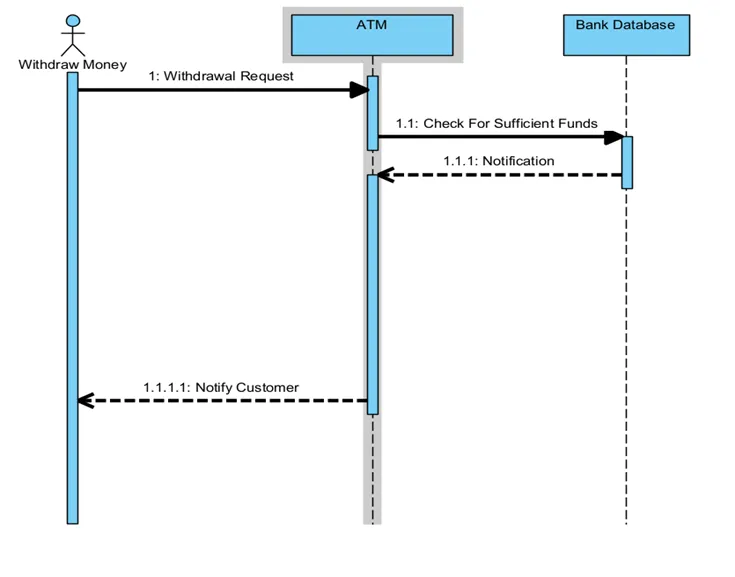
Q29. Regarding the diagram above:
(1) The object that takes the least time is the Actor.
(2) The database is needed to withdraw money.
(3) There are no return messages.
(4) Withdrawal request is stored in the database.
(5) ATM and Database have a “IS-A” relationship
Solution
(2) The database is needed to withdraw money.
Q30. The following will usually cause code to be refactored: (changing code leads to code refactoring)
(1) Changing Requirements
(2) Incremental Development Process
(3) New Features
(4) All of the above
(5) None of the above
Solution
(4) All of the above
Extra Credit: (3 Points)
What type of arguments will cause code to crash?
guidelines - null value, large value, small value,
partition based -
test 1 - less than what is expected
test 2 - more than what is expected
test 3 - what is expected
Solution
[No answer Provided in the prof’s sample final.]
Q31. What is not true about Unit Testing:
(1) Allows testing of individual parts of the software.
(2) Team can execute unit testing before the culmination of the development process.
(3) Reduces the cost of testing, as defects are identified and fixed in the early stages of development.
(4) Increases the reliability of the code.
(5) Allows for testing interactions between various parts of the code.
Solution
(5) Allows for testing interactions between various parts of the code.
Q32. Which architecture pattern is associated with a Web page?
(1) Layered pattern
(2) Client-server pattern
(3) Pipe-filter pattern
(4) Model-view-controller pattern
(5) NTier pattern
Solution
(2) Client-server pattern
Q32. Which architecture pattern is associated with an E-Mail program?
(1) Layered
(2) Client-server pattern
(3) Pipe-filter pattern
(4) Model-view-controller pattern
(5) NTier pattern
Solution
(2) Client-server pattern
Q33.

Q33. In the diagram above, A represents:
(1) Presentation Layer
(2) Business Layer
(3) Database Layer
(4) Persistence Layer
(5) Logic Layer
Solution
(1) Presentation Layer
Which type of testing would a developer probably do?
(1) Black box - hidden from developer
(2) White box - developer knows the code
(3) Acceptance - client
(4) Release - not developer
(5) Graphical User Interface - customer/GUI expert/graphical artist
Solution
(2) White box - developer knows the code
If I want to test the divide function below using “Guideline-based testing” and I already tested divide(1,2) and it correctly returned .5, what other values should I test for in the denominator?
public class Math {

    double divide(double numerator, double denominator) {
        return numerator / denominator;
    }
}
(1) 3
(2) 4
(3) 0
(4) 5
(5) 6
Solution
(3) 0
Things to know:
- Ethnography
- Software evolution - new versions/maintenance
- The diagrams
- Difference between state and activity - state is for only one object water/vapor/ice
- Multiplicity
- Pipe filter
- Static = global
- Review process diagram
- Web browser - always client/server
- Remember which non-functional specs require which architecture
- Performance - immediate response code should be together (same platform)
- Safety - code together easier to review for flaws
- Security - security layer on top
- Maintainability - code that is easy to change - usually small methods are safest to modify w/out creating bugs
- Scrum - product backlog - wish list
- Scrum backlog - for each sprint
- Potential release candidate
- Daily standup
- Testing
- All the terms are the same.. i.e. incremental, agile, xp, scrum…
- Remember OOP principles
- SOLID/YAGNI/DRY/prefer composition instead of inheritance/
- Difference between abstract and interface